
AI in Manufacturing: Turning Factory Data into Action

Manufacturing modernisation is not only about new machines. It is also about making better use of the data, systems and expertise a plant already has.
Every factory has problems it has learned to live with
Every factory has work that everyone knows is slow, manual or error-prone, and that nobody expects to change.

A safety supervisor walks the floor to spot a blocked exit. An export team checks invoices against purchase orders and letters of credit, line by line. A planner builds the morning report from several spreadsheets. A maintenance team investigates a machine only after a breakdown.
These are not necessarily failures of effort. Often, the information already exists, but it is scattered across camera footage, machine logs, inspection records and documents. People must find it, compare it and decide what to do, frequently after the event.
That gap between what a factory records and what it acts on is an opportunity for AI in manufacturing. The goal is not to add technology for its own sake. It is to help teams identify relevant exceptions sooner, make decisions with better evidence and keep people responsible for the decisions that matter.
The opportunity is already inside the plant
Manufacturers have invested in cameras, controllers, enterprise systems and digital records. Yet collecting data does not automatically make it useful. Rockwell Automation’s 2026 State of Smart Manufacturing research reports that manufacturers use only 43% of the data they collect effectively. The India findings make the gap more tangible: 60% of Indian manufacturers identify capturing, interpreting and using data as their top internal obstacle, compared with 37% globally. The same research reports that 48% of Indian manufacturers are using AI/ML learning technologies to help address labour gaps. These figures point to two connected opportunities: make better use of information plants already collect, and help people access the knowledge they need to act on it.

For some plants, the opportunity begins with video. For others, it is machine signals, inspection results or commercial paperwork. The right starting point depends on the process, the data available and the cost of the problem, rather than on choosing AI first and looking for a use for it later.
Where AI can help manufacturing teams
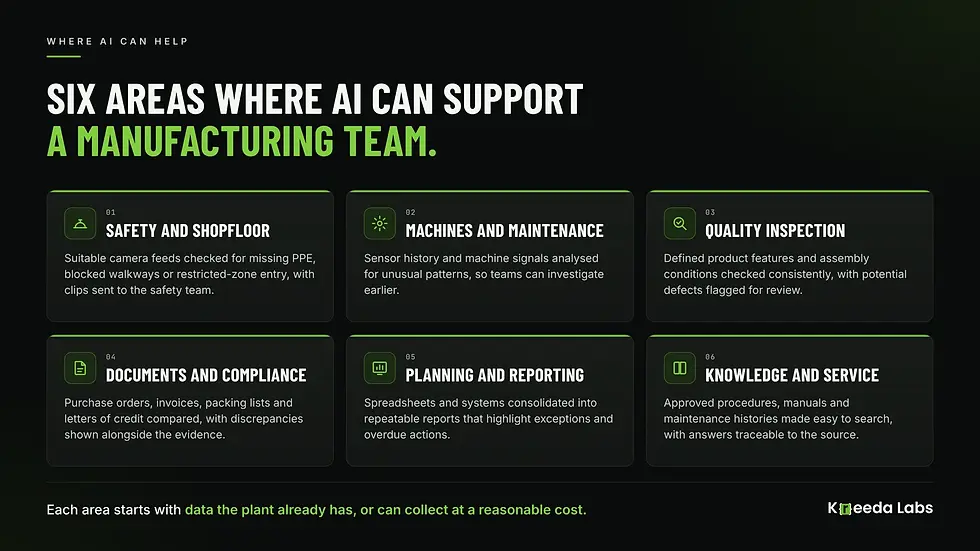
Safety and shopfloor monitoring. Computer vision can analyse suitable existing camera feeds for defined conditions, such as missing personal protective equipment, a blocked walkway or a person entering a restricted zone. When a relevant event is detected, the system can send a clip or alert to the responsible team for review. The plant’s safety personnel remain responsible for investigation and closure.
Machine monitoring and maintenance. Where reliable sensor history and machine signals are available, analytics can help teams identify unusual patterns and investigate potential problems earlier. Predictive capability depends on signal quality, equipment behaviour and validation; not every failure can be predicted from the data available.
Quality inspection. Vision systems can check defined product features or assembly conditions consistently and flag potential defects for review. Performance depends on the variation in products, lighting, camera setup and the quality of the reference examples.
Documents and compliance. AI-based document processing can extract information from purchase orders, invoices, packing lists, certificates or letters of credit, compare relevant fields and highlight discrepancies with supporting evidence. People should review exceptions and approve documents before consequential action is taken.
Planning and operational reporting. Data from existing spreadsheets and systems can be consolidated into repeatable reports that highlight exceptions, overdue actions or changes that need attention. The value comes from reducing manual preparation and making the next decision clearer.
Knowledge and service support. Approved procedures, maintenance histories and manuals can be organised so employees can find relevant information more quickly. Answers should remain traceable to the source material, especially when safety or equipment decisions are involved.
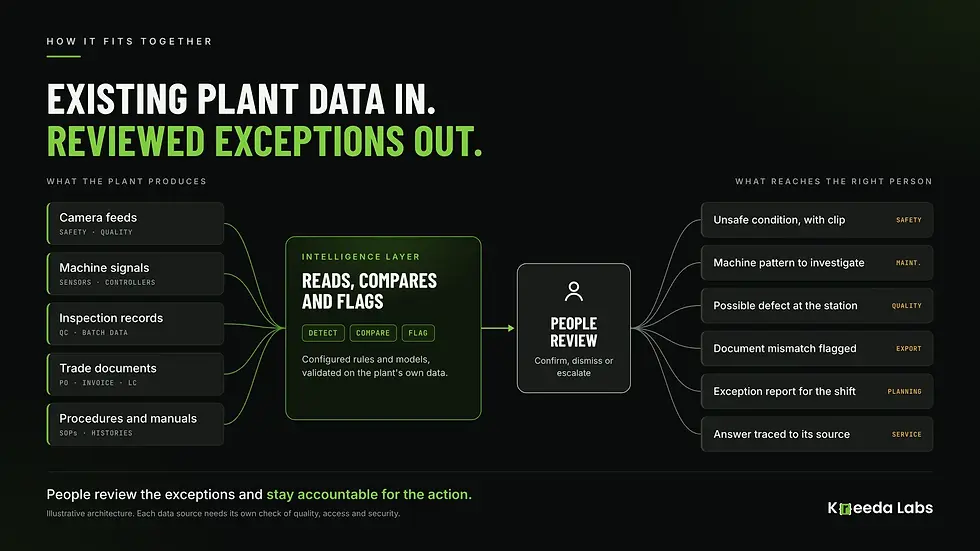
Different use cases, a shared pattern
These applications look different, but a useful candidate for AI often has four characteristics:
1. The work involves repeated observation, reading, comparison or classification.
2. Relevant data already exists, or can be collected at a reasonable cost.
3. The expected outcome or exception can be described clearly enough to test.
4. A person or team can review exceptions and remains accountable for action.
These checks are not a guarantee of success. They are a way to decide whether a use case deserves a closer assessment. If the camera cannot see the relevant area, the machine has no useful signal history, or the documents are too inconsistent to validate, the right answer may be to improve the data first, or to leave that use case out of scope.
Three realities to consider before investing
You may not need to replace existing equipment. In suitable cases, software can work with cameras, records or systems already in place. However, compatibility, compute requirements, network architecture, security and data quality must be assessed before promising that no hardware changes are needed.
Related use cases may share components. A vision system may reuse detection models and configurable rules across several safety scenarios; a document workflow may use a common extraction process with different checks. Reuse can reduce duplicated effort, but each use case still needs its own validation and operating rules.
Some requests should be declined or deferred. A camera cannot detect something outside its field of view. A model cannot reliably predict a failure without suitable evidence. A system should not promise certainty where the data cannot support it. Clear scoping is part of responsible engineering.
How to start without turning it into a large transformation programme
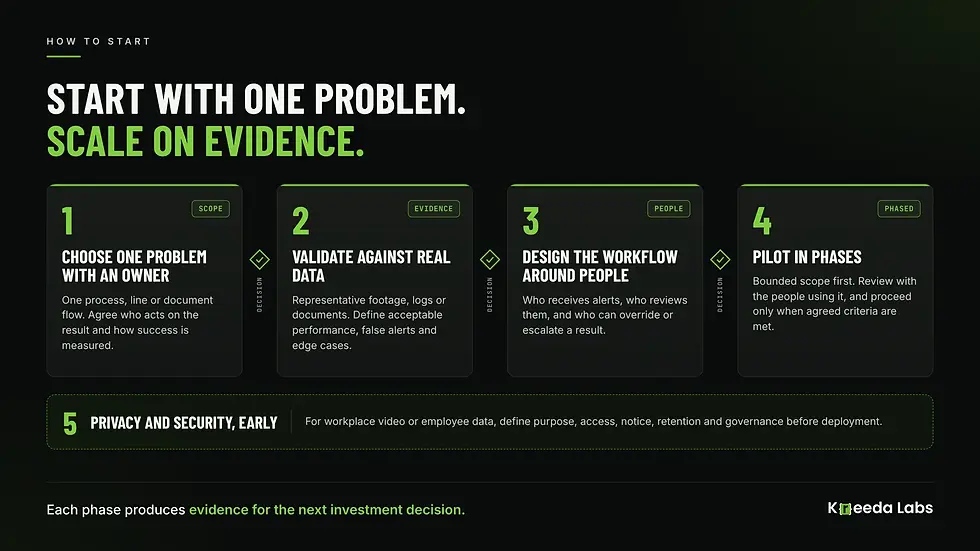
1. Choose one problem with an owner. Identify a specific process, line, document flow or recurring exception. Agree on who will act on the result and how success will be assessed.
2. Validate against real data. Test using representative footage, logs, records or documents from the plant. Define acceptable performance, false-alert handling, edge cases and the conditions under which the system should not make a decision.
3. Design the workflow around people. Decide who receives alerts, how exceptions are reviewed, how actions are recorded and who can override or escalate a result. An alert without an owner quickly becomes noise.
4. Pilot in phases. Start with a bounded scope, review performance with the people who use the system, and proceed only when agreed criteria are met. A pilot should generate evidence for the next investment decision rather than assume it in advance.
5. Address privacy and security early. For systems involving workplace video or employee information, define the purpose, access, notice, retention and governance requirements before deployment. Review applicable law and the organisation’s policies with qualified advisers.
Where Kreeda Labs fits
Kreeda Labs works on AI and software engineering, including computer vision and document-focused workflows. In manufacturing, the areas explored include vision-based safety and operational monitoring, as well as trade and shipment-document processing. These engagements have been at assessment, validation and proposal stages; they should not be presented as production deployments unless their status has changed and can be substantiated.
Our approach is to begin with the operating problem, examine the data and constraints, and establish what is feasible before committing to a solution. The objective is not to automate everything. It is to identify where software can help a team act earlier or spend less time on repetitive checking, and where it cannot yet do so reliably.

Five questions to ask your plant team
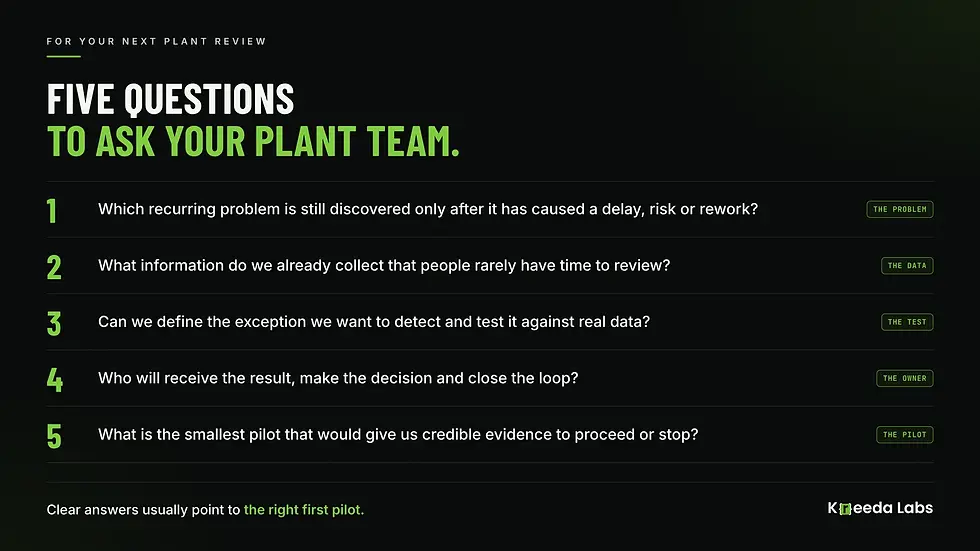
Which recurring problem is still discovered only after it has caused a delay, risk or rework?
What information do we already collect that people rarely have time to review?
Can we define the exception we want to detect and test it against real data?
Who will receive the result, make the decision and close the loop?
What is the smallest pilot that would give us credible evidence to proceed or stop?
Start with the problem, not the technology
Manufacturing modernisation does not always begin with a new machine or a plant-wide transformation. Sometimes it begins with one blocked walkway, one recurring document mismatch or one report that takes too long to prepare.
The first step is to find a problem worth solving, check whether the available data can support it, and test the approach with the people who will use it. If you are assessing an AI use case in your plant, Kreeda Labs can help explore the problem, the data requirements and a practical path to validation.


Comments